Blackball pool rules
Stokesley Pool
Visual Guide
This is a practical, visual-style guide to blackball pool rules (as played in the Stokesley Pool League (since 2010) across the UK and worldwide.
From the opening break to the completion of a frame, it covers general play, legal and illegal shots, fouls and loss of frame, snookers, combination shots, stalemates, and more.
Credit: This guide was created with the assistance of the late Peter Hawley and first published online by Bill Hunter in 2005. Revised in 2008 and 2015. Simplified with beginner's tips and refs' guidance in 2025 by John Corner (Stokesley Pool League). Original available via blackball.uk.
Terminology: In these rules, “your colour” means the balls you are playing on (reds or yellows).
1. Setting up balls and breaking off
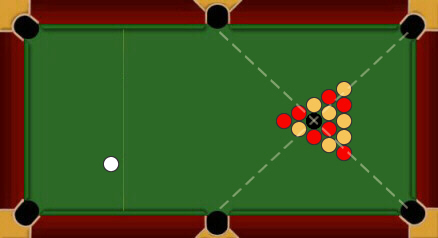 Rack the balls with the black on the spot (as shown). The lag winner decides who breaks. Players break alternately in the following frames. Place the cue ball anywhere in the baulk to break.
2. Legal and illegal breaks
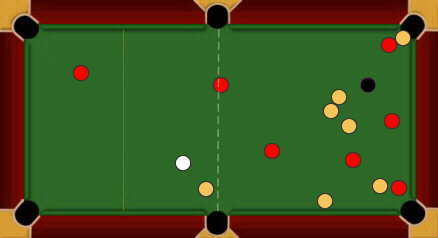
- For a legal break, pot a ball or send at least two object balls fully past the imaginary line between the middle pockets.
- If not, the incoming player gets one free shot and one visit (and may play from where the cue ball lies or from baulk), or ask for a re-rack.
- If the cue ball is potted on the break, it is a foul, and the cue ball is played from the baulk.
- If the black is potted on the break, the balls are re-racked, and the same player breaks again.
Beginner tip: After the break, the table is still open. Colours are not decided on the break.
3. Open tables and choosing colours
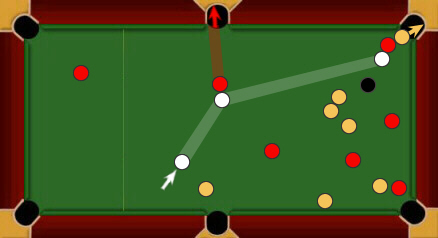 When the table is open, colours (reds or yellows) are not decided:
- On the break.
- After a foul.
- When taking a free shot.
- When a combination pots both colours in the same shot.
Outside these situations, if you pot only one colour, that becomes your colour for the rest of the frame.
4. Playing either colour on an open table
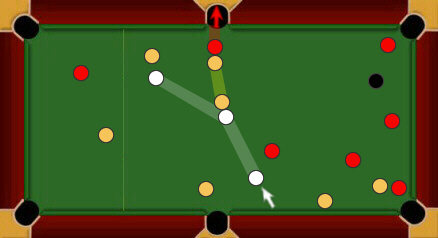 On an open table, you may strike either colour first. In this example, a yellow is played onto a red and the red drops. The player is now playing reds.
Important: The black cannot be used to pot another ball unless a foul has been committed and a free shot has been awarded.
5. What counts as a legal shot
 For a legal shot, the cue ball must hit your colour first, and then:
- Pot one of your colour, or
- Send the cue ball or any other ball to a cushion.
Referee note: The only exception is when escaping from a snooker (see section 8).
6. Snooker explained
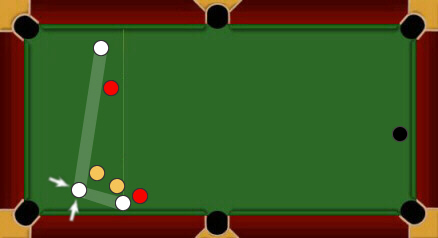 You are snookered when you cannot hit any part of your colour with a straight line shot. If you believe it is a total snooker, ask the opponent or referee to confirm.
7. Laying snookers
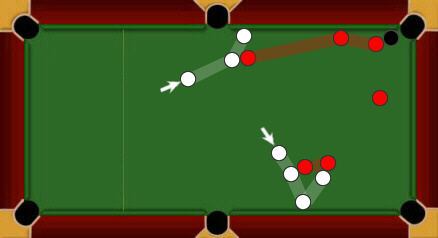 Most of the time, a legal shot requires a ball to touch a cushion after hitting your colour. You cannot simply roll the cue ball gently behind another ball to leave a snooker.
In the first example, either the cue ball or the red must touch a cushion after the red is struck. In the second example, the cue ball clips a red, reaches a cushion, and finishes hidden behind two reds. This is a legal shot.
8. Escaping a snooker
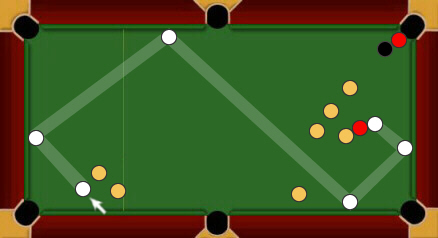 When escaping a snooker, no ball needs to touch a cushion. The shot is legal as soon as the cue ball makes contact with your colour.
Beginner tip: This includes swerve shots.
9. Balls leaving the table
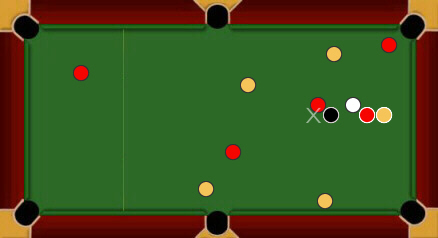 If any ball leaves the table, it is returned to the playing surface. If the cue ball leaves the table, it is played from the baulk.
Object balls are re-spotted on (or as close as possible to) the black spot, in a straight line towards the nearest end cushion.
If the table is open, balls are replaced in this order: black, red, yellow. If the table is not open, the black is replaced first, followed by the balls of the player about to play.
10. Combination shots
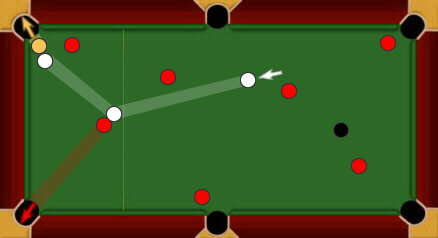 You may pot two or more balls in a single shot without penalty. These may be either colour and may include the black.
The balls can fall in any order, but the cue ball must first strike a ball you are allowed to hit.
11. Winning the frame with a combination
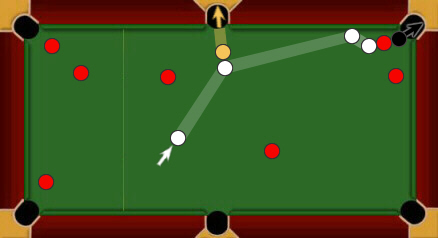 You may pot your final colour ball (or balls) and the black in the same shot to win the frame, as long as the cue ball hits your colour first.
12. Same-pocket combination
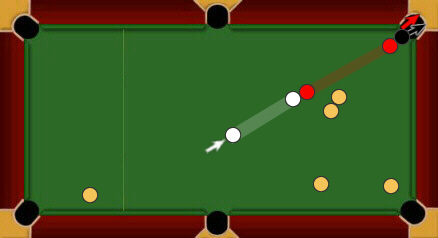 In some situations, two balls can be potted into the same pocket. Here, the red pots the black and then follows it into the same pocket to win the frame.
13. Combination on a free shot
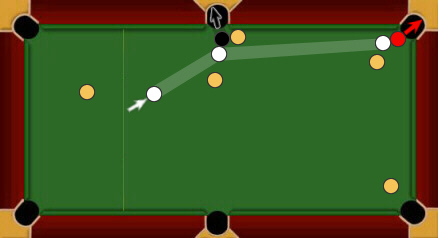 After a foul, you have a free shot and may strike any ball first. In this example, the player on reds pots the black and then pots the final red in the same shot to win.
Referee note: Potting only the black here is still loss of frame.
14. Playing away from a touching ball
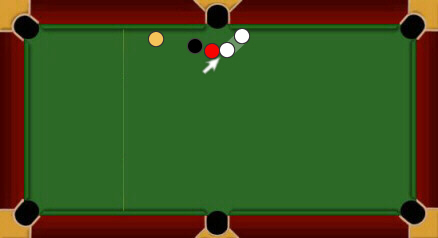 If the cue ball is touching another ball, you must play away from it. If the touching ball moves, it is a foul.
If the cue ball is touching your colour, that ball is treated as already struck. The shot must still be legal.
Referee note: If touching a ball that is not the player's colour, the cue ball must still make first contact with the player's colour after playing away.
15. Another touching ball example
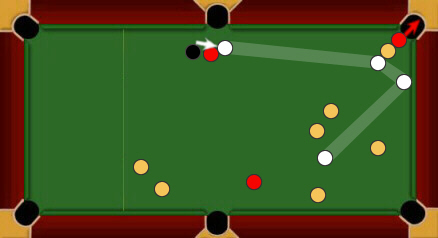 The cue ball is touching a red. Because the player is on reds, that red is treated as already struck. The player can then play away, hit the yellow, and pot the red.
16. Free shot after a foul
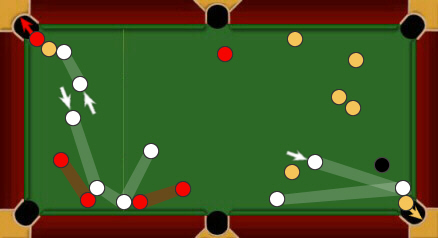 After a foul, the table is open and the incoming player has a free shot. Any ball may be struck first, and any ball may be potted.
17. Loss of frame (deliberate foul)
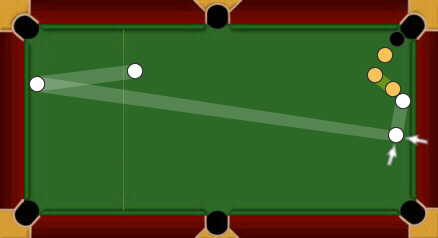 You lose the frame if you clearly make no genuine attempt to hit your colour, or deliberately strike a ball that is not yours. Also, deliberately touching or picking up a ball when not entitled to do so.
Referee note: Consider the player's local league ability and intent when judging deliberate fouls. A player 'catching' a ball when it's going in the pocket is a loss of frame.
18. Foul, but not loss of frame
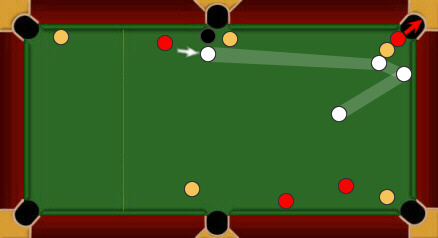 Here, the player strikes their colour first but pots an opponent’s ball. This is a standard foul, not a loss of frame.
19. Stalemate
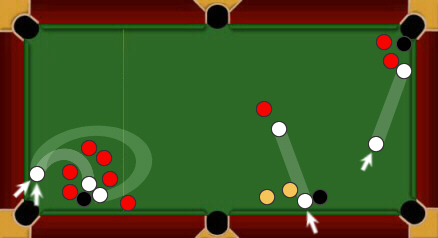 If no legal shot is available, the frame is restarted with a re-rack. This is a stalemate.
20. Unsportsmanlike conduct
Players
Players are expected to behave in a sporting and respectful manner at all times.
Any deliberate action that disrupts play, distracts an opponent, or brings the game into disrepute may be treated as unsportsmanlike behaviour.
Examples include distracting an opponent, deliberately miscuing, marking or damaging the table, or misusing equipment.
Referee discretion:
The referee has full discretion to deal with unsportsmanlike behaviour.
Depending on the severity of the offence, the referee may issue a warning, award a standard foul, declare loss of frame, or award the match to the opponent.
Serious or repeated offences may result in removal from the competition and the loss of prizes, trophies, or league points.
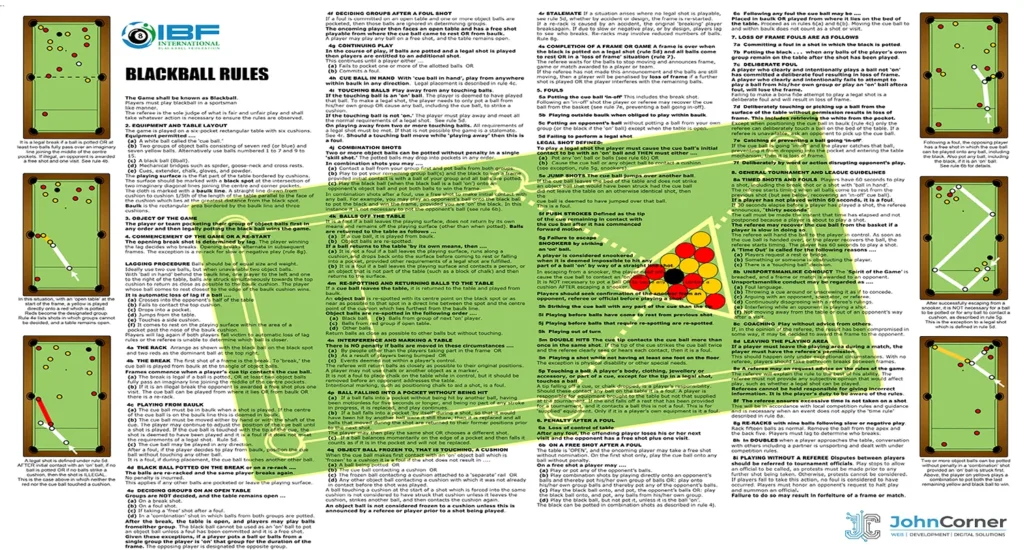
Printable Rules
Download a printable A3 copy of the Blackball pool rules for quick reference during league and club play.